
Wedding venue sound restrictions can affect everything from your entertainment setup to the timing of your last dance. Before finalizing a band, DJ, or interactive performance, confirm exactly when amplified music must end, where speakers may be used, how volume is measured, and what happens if the venue determines that the music is too loud.
These policies do not have to diminish your celebration. They do, however, need to be part of the plan from the beginning. Clear answers allow your venue and entertainment team to design a reception that feels energetic without creating last-minute equipment changes, timeline disruptions, or unexpected pauses.
Why Sound Restrictions Deserve Attention Before You Book
Venues may limit sound because of local requirements, nearby homes, shared event spaces, property policies, or the acoustics of a particular room. Restrictions are especially common at outdoor venues, historic properties, hotels, vineyards, and sites near residential neighborhoods.
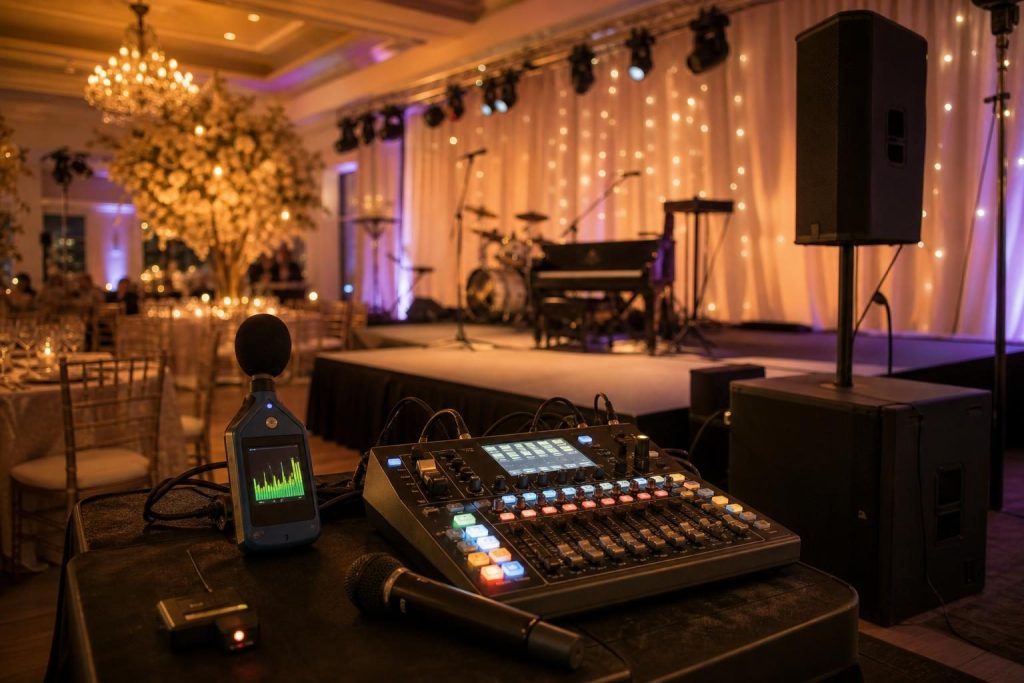
The phrase “music must end at 10 p.m.” may sound straightforward, but it can have several meanings. It might apply only to outdoor amplification, or it might require all entertainment to stop. Some venues allow quieter background music after the main curfew, while others require speakers to be completely powered down.
Ask for the venue’s sound policy before signing entertainment contracts. If you have already reserved the venue, share the policy with prospective performers before selecting a package. A setup designed for a ballroom may need to change substantially for a patio with a strict decibel cap.
Confirm the Curfew for Every Part of the Property
Do not assume the ceremony lawn, cocktail patio, and reception room follow the same rules. Ask the venue to explain the policy for each space you plan to use, including any rain-plan location.
- What time may amplified music begin and end in each area?
- Does the curfew apply to live music, recorded music, microphones, or all amplified sound?
- Can quieter music continue after the main entertainment ends?
- Must patio doors and windows remain closed while music is playing?
- Are there different restrictions on weekdays, weekends, or holiday dates?
- Does the backup indoor or covered space have separate limitations?
Also confirm whether the listed end time means the final song must be finished or whether equipment must be fully shut down by then. A ten-minute difference can affect the last dance, formal exit, and vendor load-out plan.
Understand Decibel Monitoring and Limiter Systems
If a venue provides a decibel number, ask how that number is measured. The location of the meter matters: a reading taken beside a speaker will differ from one taken at the property line. It is also helpful to know whether staff monitor brief peaks, an average level, or both.
Some venues use a sound limiter connected to the entertainment system. Depending on the setup, the device may display a warning, reduce the signal, or interrupt power when sound exceeds a preset threshold. Ask the venue these questions:
- What is the permitted level, and where is it measured?
- Who monitors the reading during the reception?
- Is there a warning before intervention?
- Does the limiter reduce audio or cut power?
- Who provides and tests the limiter?
- Can the entertainment provider inspect the system before the wedding?
A decibel cap does not always translate neatly into a guest experience. Room shape, hard surfaces, ceiling height, crowd noise, speaker placement, and bass frequencies all influence perceived volume. Your entertainment provider should receive the venue’s exact specifications rather than a general instruction to “keep it reasonable.”
Ask About Required Equipment and Setup Rules
A venue may require performers to use an installed sound system, an approved audio vendor, or a designated sound engineer. Other properties prohibit subwoofers, limit the number or size of speakers, or require speakers to face away from neighboring homes.
Confirm whether the house system can support every part of your event, including musicians, playback tracks, wireless microphones, introductions, and toasts. If your entertainment team must bring equipment, ask about electrical access, cable paths, stage dimensions, setup times, and weather protection for outdoor areas.
This is also a good time to discuss the floor plan. Strategic speaker placement can provide clear, even coverage without forcing excessive volume near the dance floor or dining tables. Felix & Fingers regularly coordinates the production needs of interactive wedding entertainment with venues, planners, and other vendors, and early access to accurate venue information makes that coordination much smoother.
Document Who Enforces the Policy
Sound rules are easier to manage when everyone knows who can make decisions during the reception. Ask the venue to identify the on-site contact responsible for monitoring volume. That person might be a venue manager, banquet captain, coordinator, security representative, or audio technician.
Your entertainment provider should know whom to consult if a warning occurs. Ideally, any volume request should go directly to the bandleader, DJ, or audio lead rather than through guests or members of the wedding party.
Include the venue contact and key sound notes in your event documents. A practical wedding MC cue sheet can also keep major moments aligned with the music deadline.
Before the wedding, obtain written confirmation of:
- Amplified-music start and stop times
- Decibel limits and measurement locations
- Indoor, outdoor, and rain-plan rules
- Required or prohibited audio equipment
- House-system fees or required technical staff
- The venue’s warning and enforcement process
- The names and contact information of day-of decision-makers
Share the same information with your planner and entertainment provider. If policies change, circulate the updated version so the team is not relying on conflicting instructions.
Preserve Reception Energy When Loud Music Must End Early
A strict curfew does not mean your reception has to end on a flat note. It may simply require a more intentional timeline. Consider opening the dance floor earlier, shortening long gaps between formalities, or moving dinner speeches so they do not consume prime entertainment time.
Schedule priority songs—including parent dances, anniversary dances, and your must-play dance selections—before the amplified-music cutoff. If appropriate for your event, your entertainment team can group introductions, dinner transitions, and formal moments efficiently so guests reach the dance floor sooner.
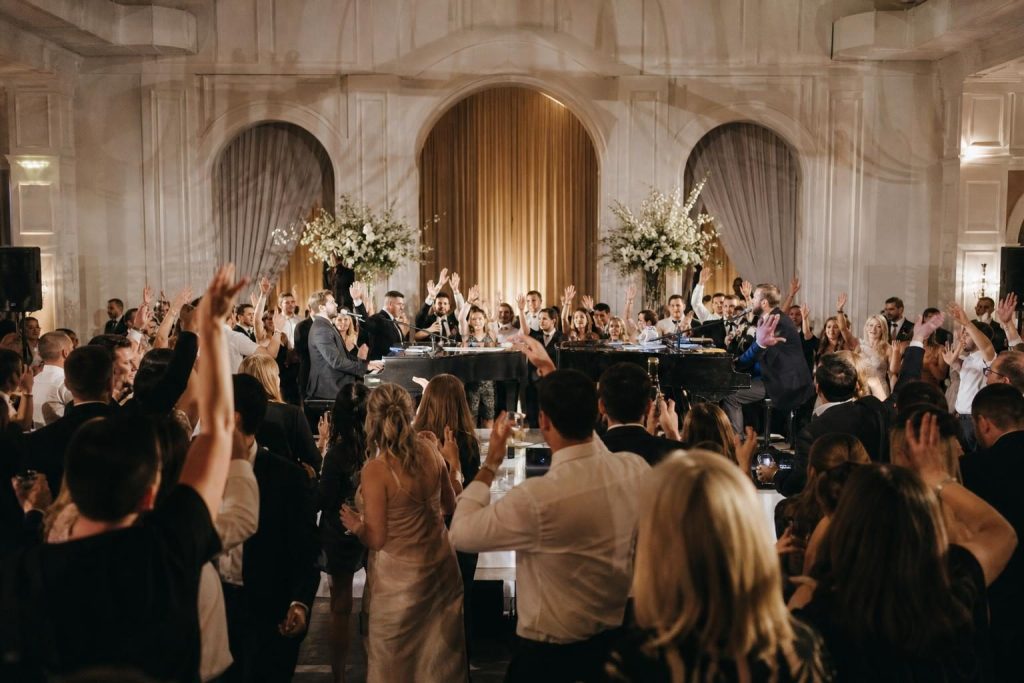
When outdoor amplification must end before the reception does, moving guests to an approved indoor room may preserve the party. If continued amplification is not permitted anywhere, discuss lower-volume options with the venue and performers. Depending on the policy, possibilities may include acoustic music, guest-request moments, audience participation, a piano-led singalong, or a silent-disco setup. Each option still requires venue approval.
Interactive entertainment can help maintain engagement even when maximum volume is not possible. Strong pacing, familiar songs, thoughtful lighting, and clear transitions often contribute as much to the atmosphere as sheer loudness. Couples exploring this format can learn more about how dueling pianos work.
A Clear Sound Plan Protects the Celebration
The essential takeaway is simple: get the venue’s complete sound policy in writing, share it with your entertainment provider, and build the reception timeline around it. Confirm the curfew, measurement method, equipment rules, rain-plan restrictions, and on-site enforcement contact before approving the final setup.
Planning entertainment for a venue with specific sound requirements? Contact Felix & Fingers at (800) 557-4196 or request an instant quote to start discussing your wedding plans.