
A great wedding MC cue sheet turns your reception plans into clear, usable instructions for the person holding the microphone. It helps your entertainment team announce the right people, say names correctly, coordinate with vendors, keep dinner moving, and guide guests through the night without repeatedly pulling you aside for answers.
The best cue sheets are not fancy. They are specific, easy to scan, and realistic. Whether your MC is your DJ, bandleader, dueling pianos team, planner, or a trusted friend, they need more than a general timeline. They need names, pronunciations, order of events, cue sources, and backup contacts in one place. These are all details that we collect in our wedding questionnaire.
At Felix & Fingers, our performers often support the flow of the reception while providing interactive live entertainment, so we see firsthand how much smoother the evening feels when the MC has the right information before guests arrive. Here is how to build a cue sheet your entertainment team can actually use.
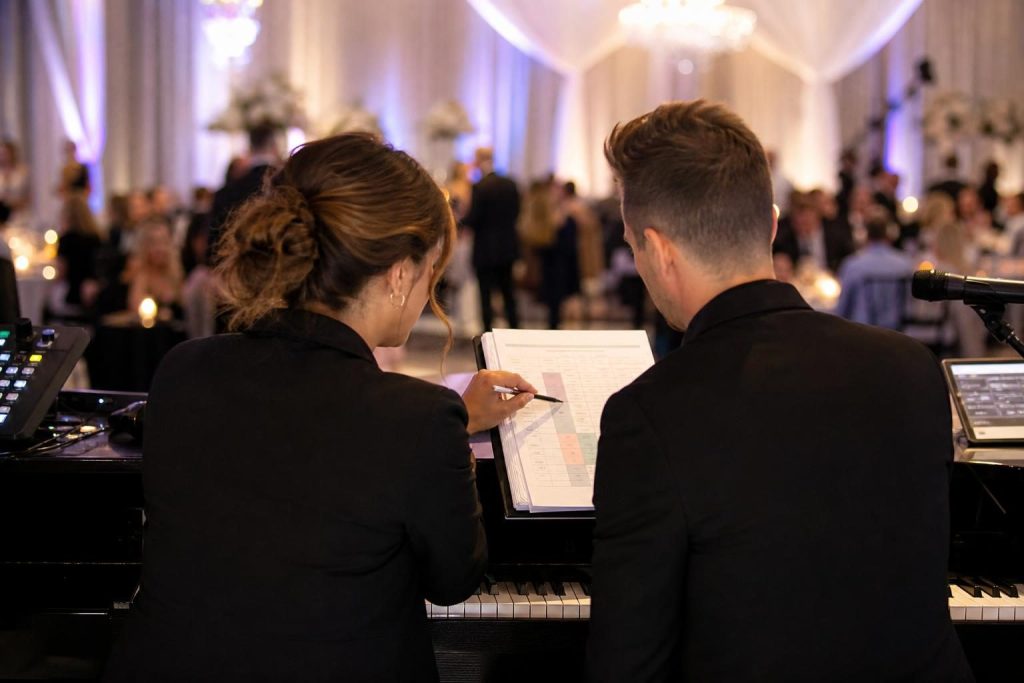
Start With the Basics Your MC Needs at a Glance
Your cue sheet should begin with a quick reference section. This is not the place for every design detail or a full planning binder. Think of it as the front page your MC can check quickly when something changes or a vendor has a question.
Include:
- Couple’s full names and preferred married name usage, if applicable
- Wedding date, venue name, and reception room or outdoor location
- Planner or day-of coordinator name and cell number
- Primary venue contact and catering lead
- Photographer and videographer contacts
- Entertainment team contact and arrival/setup notes
- Emergency contact who is not getting married
- Any hard stop times for music, bar service, shuttles, or venue access
That last point matters. If the venue requires all amplified sound to end at 10:00 p.m., your MC should know that before making a crowd-pleasing announcement that accidentally pushes the schedule too late. Likewise, if shuttle buses leave at set times, the MC may need to remind guests without making it sound chaotic.
List Wedding Party and Family Introductions Clearly
Introductions are one of the most common places a reception can feel awkward if the cue sheet is vague. Your MC needs the correct entrance order, relationship labels, pronunciation guidance, and any special instructions about who should or should not be announced.
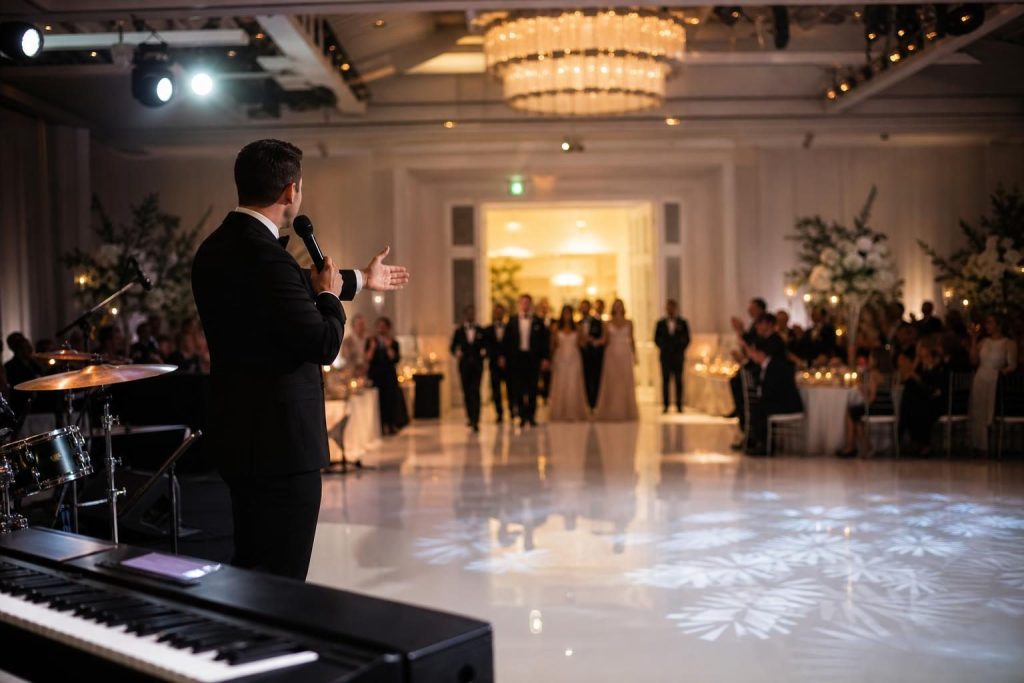
For each person, include:
- Full name as it should be spoken
- Pronunciation written phonetically
- Relationship to the couple
- Entrance partner, if any
- Preferred title or label, such as parent, sibling, friend, best person, or person of honor
- Any sensitivity notes, such as divorced parents entering separately
Pronunciation notes should be written for sound, not spelling. For example, “Nguyen” may be noted as “WIN,” “NWIN,” or another pronunciation depending on the family. Do not assume your MC will know. If a name is especially important or commonly misread, add “please confirm with coordinator before introductions.”
Instead of writing, “Announce wedding party,” write something like: “Grand entrance order: 1) Parents of Alex: Maria and Thomas Rivera, pronounced ree-VAIR-uh. 2) Wedding party: Jordan Lee and Priya Shah, pronounced PREE-yuh SHAH. 3) Couple: Alex Rivera and Morgan Chen. Use: ‘Please welcome the newly married Alex and Morgan!’”
If you are still choosing music for this moment, our guide to wedding party introductions can help you think through the energy you want before your MC reads the room.
Build the Reception Timeline Around Cues, Not Just Times
A timeline that only lists times is helpful, but a cue sheet should also explain what triggers each announcement. Weddings rarely move by the minute. Photos run long, dinner service shifts, and guests take time to transition. Your MC needs to know whether to act at a specific time or wait for a vendor cue.
For each reception segment, list the scheduled time, the cue source, the announcement wording or purpose, and the next handoff. This helps everyone avoid stepping on each other.
For example:
- 5:45 p.m. Cocktail hour ends: Coordinator confirms room is ready. MC invites guests to find seats.
- 6:00 p.m. Grand entrance: Photographer and videographer must be in place before announcement begins.
- 6:10 p.m. Welcome toast: MC introduces father of the bride, Daniel Brooks. Mic remains live at head table.
- 6:20 p.m. Dinner service: Catering lead gives MC permission to release tables or announce buffet.
Notice the difference between “Dinner at 6:30” and “Catering lead signals when salads are placed; MC announces that dinner service has begun and asks guests to remain seated until their table is invited.” The second version gives the MC an action, a condition, and a tone.
If your entertainment team is also providing reception guidance, share the cue sheet early enough for questions. You can learn more about how Felix & Fingers approaches wedding entertainment on our weddings page.
Clarify Toast Order, Meal Service, and Vendor Timing Notes
Toasts are another area where small details make a big difference. Your cue sheet should list each speaker in order, their relationship to the couple, pronunciation notes, where they will be standing or seated, and whether they need a handheld microphone.
Include any boundaries, too. If you want toasts kept brief, do not ask the MC to police that in a harsh way from the microphone. Instead, have your planner or coordinator remind speakers privately before the reception. The MC can support the flow by introducing each toast cleanly and transitioning smoothly afterward.
A useful toast entry might read: “Toast 1: Taylor Kim, sibling of Morgan, pronounced TAY-ler KIM. Standing at head table. Handheld mic. MC intro: ‘We’ll begin with a few words from Morgan’s sibling, Taylor.’ After toast, MC introduces best man, Marcus Allen.”
Meal service notes should be just as practical. Your MC may need to know whether dinner is plated, buffet, stations, family-style, or food truck service. Each format changes the announcement style. A buffet may require table releases. Stations may need a reminder that multiple areas are open. Plated service may require guests to stay seated so servers can work efficiently.
Vendor timing notes belong on the cue sheet when they affect announcements. Examples include:
- Photographer needs couple outside for sunset portraits at 7:15 p.m.
- Videographer wants clean audio for toasts and private vows, if applicable
- Catering needs a five-minute warning before cake cutting
- Venue staff will dim lights before first dance
- Planner will cue the sparkler send-off, not the MC
The goal is not to make your MC responsible for every vendor. It is to help the person speaking to the room avoid calling attention to a moment before the people capturing, serving, or staging it are ready.
Spell Out Special Dances, Surprise Moments, and Music Boundaries
Special dances should have exact song titles, artist names, versions if important, and start/stop instructions. If you want the first dance faded after two minutes, put that in writing. If a parent dance begins with one parent and then invites others halfway through, explain the cue.
Vague instruction: “Play our first dance song and then parent dances.”
Useful instruction: “First dance: ‘Coming Home’ by Leon Bridges, fade at 2:15 after chorus. MC invites all guests to gather around dance floor before song begins. Parent dance follows immediately: Morgan with father Daniel for first verse, Alex and mother Renee join at 1:05.”
Surprises need even clearer handling. If you have a choreographed dance, a late-night snack reveal, a private song request, a birthday acknowledgment, or a cultural tradition that not all guests will recognize, your MC should know who cues it, what to say, and what not to reveal too early.
Also include request boundaries. Interactive entertainment thrives when guests feel included, but your entertainment team still needs your preferences. You do not have to create an exhaustive do-not-play list, but you should mention any firm limits.
Examples:
- “Guest requests welcome, but no explicit versions while grandparents are present.”
- “Please avoid breakup songs during dinner and formal dances.”
- “Country requests are fine; couple prefers no line dance announcements unless dance floor needs help later.”
- “Do not play college fight song until after toasts; alumni group is planning a surprise.”
These notes give your entertainment team room to read the crowd while honoring your priorities. If guests are curious about the interactive style itself, this overview of dueling pianos explains how live requests and crowd energy can work together.
Use Vague Versus Useful Instructions to Tighten the Sheet
Before you send your cue sheet, read it as if you know none of the family dynamics, no one’s name, and nothing about the venue. Anywhere you see a general statement, replace it with an action.
Here are common upgrades:
- Vague: “Announce parents.” Useful: “Announce Elena Martinez, mother of Jamie, and Robert Collins, stepfather of Jamie. Jamie’s father is not attending; do not reference.”
- Vague: “Do cake cutting after dinner.” Useful: “Cake cutting after catering clears entrees and photographer confirms position. MC invites guests to direct attention to cake table; no need to gather everyone around.”
- Vague: “Open dance floor.” Useful: “After anniversary dance, MC invites all guests to join the couple on the dance floor. Start with upbeat Motown, then move into current pop if crowd responds.”
- Vague: “Mention shuttle.” Useful: “At 9:45 p.m., announce first shuttle departs from main entrance at 10:00 p.m.; second shuttle at 10:45 p.m. Keep tone light.”
- Vague: “Do bouquet thing.” Useful: “No bouquet toss. Couple will present bouquet privately to grandmother during dessert. Photographer and planner cue only; no public announcement.”
This level of detail does not make the reception rigid. It actually gives your MC more confidence to adjust because the important boundaries are already clear.
Finalize, Share, and Keep One Person in Charge of Updates
A cue sheet becomes confusing when five people send separate changes. Choose one person to own the final version, usually the planner, coordinator, or one member of the couple. Ask vendors to send notes to that person instead of creating parallel documents.
Send a draft to your entertainment team about two to four weeks before the wedding, then send the final version during the wedding week. If you are still inside your final 30 to 60 days, that is a perfect time to start gathering pronunciations, family notes, and vendor cue preferences.
Keep the format simple. A shared document, spreadsheet, or PDF can all work. What matters most is that the MC can scan it quickly. Use bold event names, keep announcements short, and place pronunciation notes directly beside the name rather than on a separate page.
On the wedding day, print at least one copy for the MC or entertainment lead and one for the coordinator. Digital versions are convenient, but printed notes can be easier to reference during a busy reception.
Concise takeaway: your wedding MC cue sheet should answer who is being announced, how names are pronounced, when each moment happens, who gives the cue, what vendors need before it begins, what music or request boundaries apply, and who can make decisions if plans shift.
If you want an entertainment team that understands both the music and the moving parts of a reception, Felix & Fingers would be happy to help. Call us at (800) 557-4196 or request an instant quote to start planning.